What “seamless” actually means
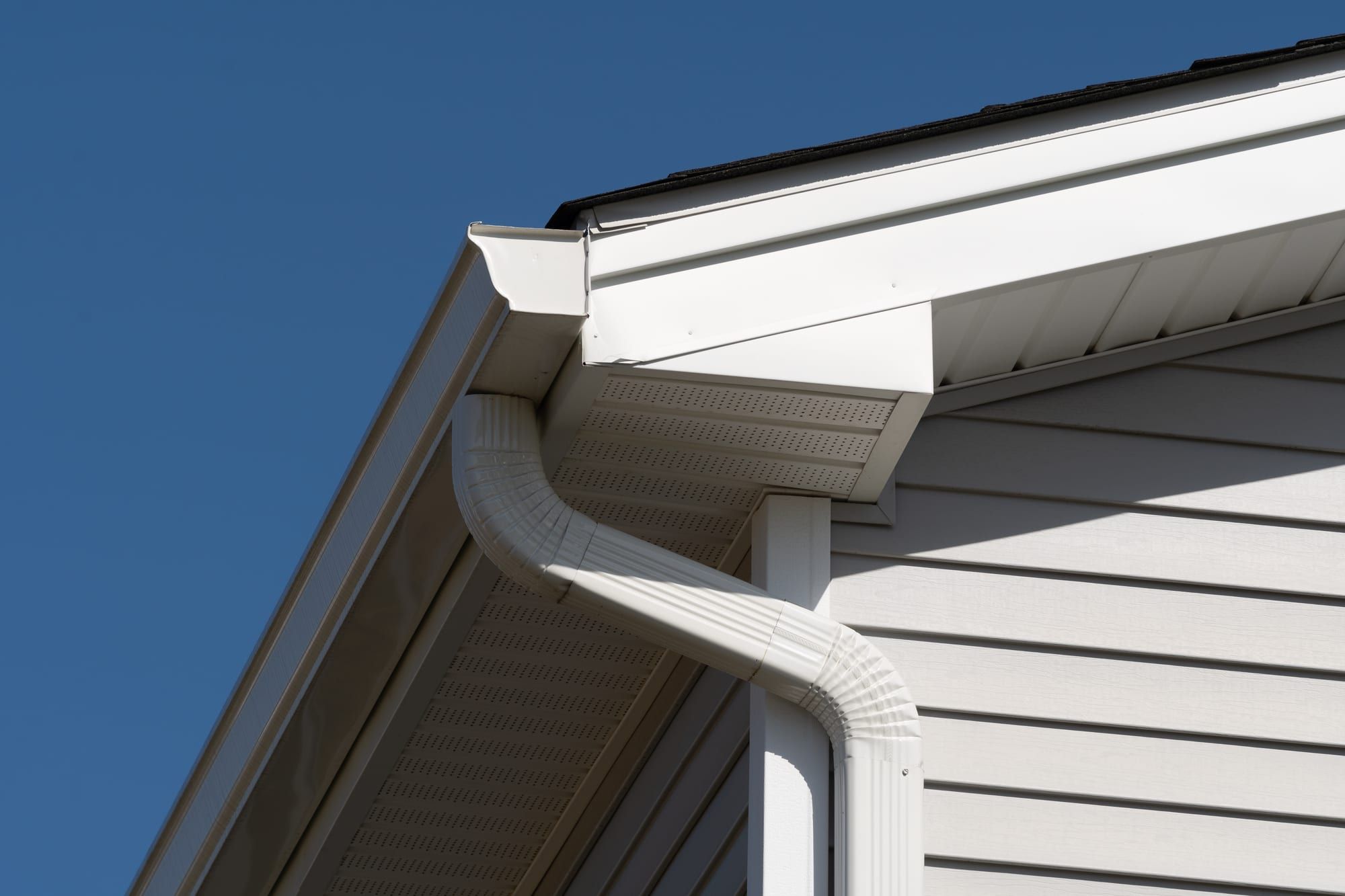
A seamless gutter is formed on site. A truck-mounted machine takes a coil of aluminum and rolls it into one continuous length for each side of your roof, cut to your exact measurement. Instead of the pre-cut ten-foot sections a sectional gutter is assembled from — each joined with a sealed seam — a seamless run has seams only at the corners and downspouts. On a typical Omaha home that takes the number of joints from dozens down to a handful.
That single difference is why “seamless” is worth understanding rather than just buying. Every joint is a weak point. Fewer joints means fewer weak points, and in Omaha that matters more than it does almost anywhere.
Why seams fail faster in Nebraska
Here’s the whole argument for seamless, and it’s a climate argument, not a sales pitch. Nebraska can swing more than 40 degrees in a single day — a February afternoon in the 50s dropping into the teens overnight is ordinary here. Water sitting in a gutter joint freezes, expands, and thaws on that daily cycle, over and over, all winter.
Every one of those cycles works on the seams of a sectional gutter. The sealant at each joint cracks. The fasteners loosen. The end caps and miters separate. Sectional gutters don’t fail here because they’re badly made; they fail because the climate attacks the one thing they have a lot of — joints. Seamless removes almost all of those joints, so there’s almost nothing for the freeze-thaw cycle to pull apart. That’s why a seamless system installed today is still holding its line years after a sectional one would be leaking at every seam.
The corners and downspout outlets are still joints, and they’re where a seamless gutter will eventually need attention. But those are a handful of spots you can see and reach, not a leak hiding somewhere along a hundred feet of run.
How on-site fabrication works
The reason seamless can be cut to your exact roof is that it isn’t made in a factory. The forming machine rides on the installer’s truck, and aluminum coil feeds through it and comes out the other end as a finished gutter in whatever length the run needs. Each side of the roof is measured, and one continuous piece is rolled to match — no splicing, no ten-foot sections butted together on a ladder.
That’s also why a seamless install is usually a one-day job on a typical Omaha home. There’s no factory lead time and no waiting on pre-cut lengths. The crew measures, forms each run on the spot, hangs it on hangers spaced for Nebraska’s ice and debris load, sets the pitch toward the downspouts, routes the downspouts away from the foundation, and cleans up. On an older home in Dundee or Benson, the crew also checks the fascia before hanging anything, because a beautiful seamless gutter screwed into rotted wood is a callback waiting to happen. The fabrication is the easy part; the measuring, pitch, and hanging are where the craft actually lives.
K-style vs. half-round, and 5-inch vs. 6-inch
Two choices actually matter for an Omaha home, and the cross-sections below show each one at a glance.
Profile. K-style is the standard, and for good reason: its flat back mounts cleanly to the fascia and its shape holds more water than a half-round of the same width. Half-round is a historic-home look — genuinely the right call on certain older houses in Dundee, Field Club, and parts of Benson where it fits the architecture — but it holds less water and costs more. For most homes, K-style is the answer.
Size. 5-inch K-style is standard and handles most older Omaha homes with modest roofs. 6-inch gutters paired with larger 3x4 downspouts are the right move on the newer, bigger-roofed builds out in Elkhorn, Gretna, Bennington, and Papillion. A large, steep roof sheds a lot of water fast in a Nebraska thunderstorm, and a 5-inch gutter simply can’t carry that volume — it overshoots and dumps at the foundation. The upsize is a small cost for gutters that actually work when it pours.
Colors, materials, and what actually matters
Aluminum is the right material for almost every home in Omaha. It won’t rust, it comes in dozens of baked-on colors that hold up to the sun, and it takes the freeze-thaw without complaint. Steel dents less but rusts over time in a climate with real snow. Copper is beautiful and costs several times as much — a genuine aesthetic choice for a Dundee or Country Club home, not a value one. And vinyl is a mistake in this climate: it gets brittle in the cold and cracks, so you end up replacing it far sooner than you would aluminum.
Beyond material, the details that actually determine how long your gutters last are the ones you can’t see from the curb: the gauge of the aluminum, and how the runs are hung and pitched. Heavier stock and correct hanger spacing carry Omaha’s winter load of wet debris and ice; thin stock and wide spacing sag. It’s worth asking any installer about both. For how all of this affects the price, see the Omaha gutter cost breakdown.
Seamless is also the right foundation for the rest of the system. If you’re adding gutter guards, they sit best on a properly sized seamless gutter. If your current gutters are failing, a full replacement is the moment to go seamless and right-size at the same time.
Get a free seamless gutter estimate
Tell us the rough footage and whether your roof is a big newer one or a modest older one, and you’ll get a straight recommendation on profile and size along with a real number. No pressure, and an honest answer on what your specific Omaha home actually needs. Contact us or call for a free estimate.