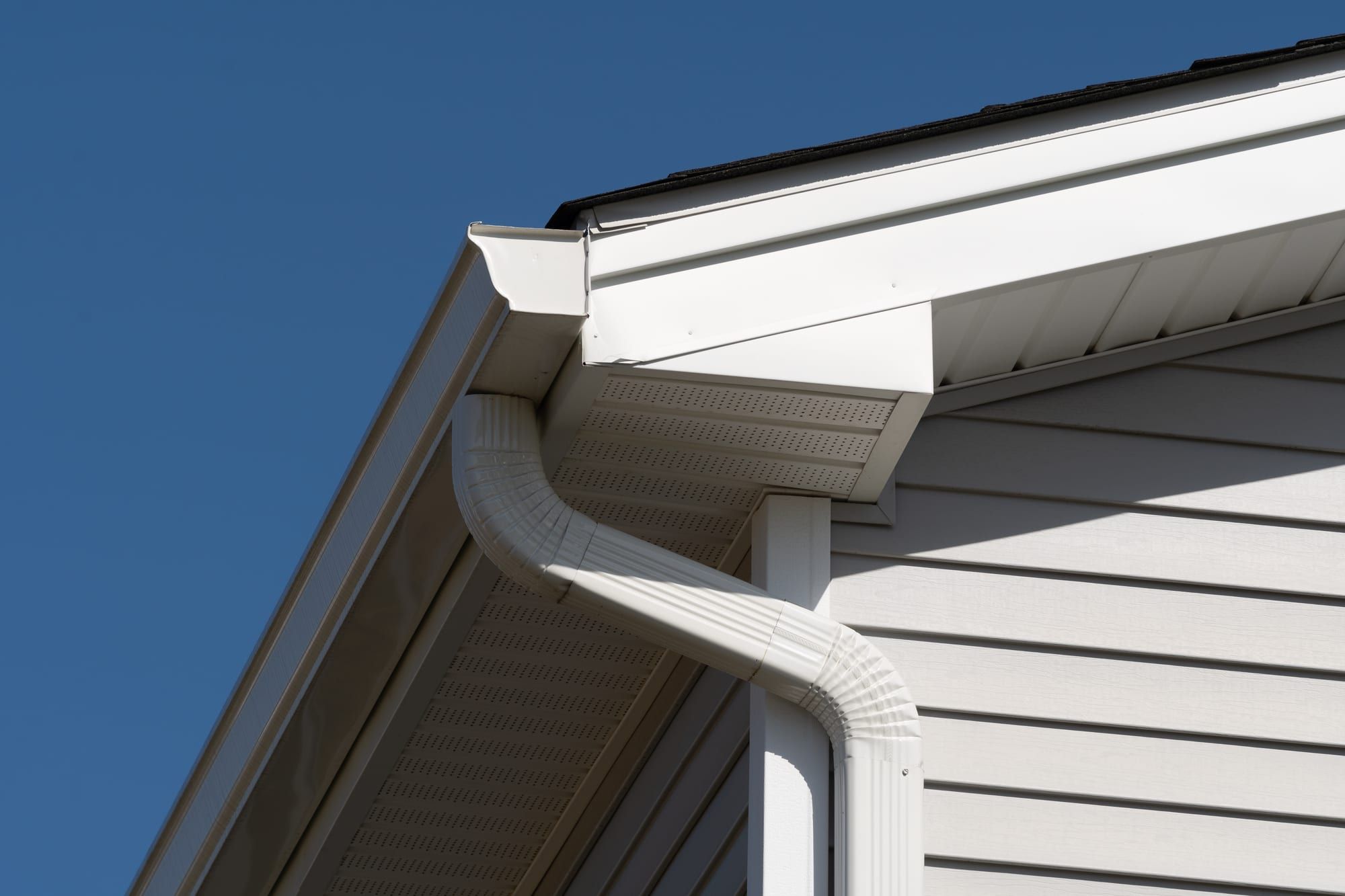
The five things that actually go wrong with Omaha gutters
Most gutter trouble in Omaha comes down to five failure modes, and knowing which one you have tells you whether a repair will hold.
- Split seams. Nebraska swings more than 40 degrees in a single day, and that freeze-thaw cycle cracks the sealant at every joint of a sectional gutter. Leaks show up at the seams first.
- Sagging. Wet debris and, in winter, ice load get heavy. Hangers spaced too far apart let the run bow in the middle, and once it sags, it stops draining and holds more water and debris — a spiral that gets worse.
- Wrong pitch. A gutter has to slope slightly toward the downspouts. If it doesn’t, water stands, and standing water is what finds every weakness.
- Pulling away from the house. This is the big one, and it’s covered in its own section below, because it’s almost never really a gutter problem.
- Crushed or disconnected downspouts. A downspout that’s dented, clogged, or dumping at the foundation stops moving water where it needs to go, and a wet basement follows.
The one behind the gutter: rotted fascia
Here’s the most useful thing on this page, and it’s the thing most competitors leave out because it complicates the sale. When a gutter is pulling away from the house in an older Omaha neighborhood, it is usually not a gutter problem. It’s a wood problem.
The gutter is screwed into the fascia — the wood board along the roof edge. On pre-1950 homes in Dundee, Benson, Field Club, and Hanscom Park, that board has often been getting wet for years, from an overflowing gutter or a bad drip edge, and it’s gone soft. Screw a gutter into rotted fascia and it holds for a few weeks and then tears loose again, because there’s nothing solid for the fastener to bite. Re-hanging it is a repair that fails within a season, guaranteed.
The honest fix is to replace the rotted fascia first, then hang the gutter into sound wood. That costs more than a re-hang — fascia and soffit work runs $4 to $22 per linear foot, up to $9 to $34 for full soffit-and-fascia, and an Omaha fascia-board repair commonly runs $400 to $900. We tell you that up front so the number doesn’t ambush you, and so you understand why the cheapest “just re-hang it” quote is the most expensive one in the long run.
Repair or replace?
The line is simpler than it sounds, and the flowchart below walks it through step by step.
Repair when the system is basically sound and the problem is local: one leak, one loose run, one bad downspout. Replace when the problems are spread out — multiple leaking seams, sagging along the length, wrong pitch throughout, gutters pulling away from fascia that’s rotted, or gutters that are simply undersized for the roof.
Many people searching for a repair are actually replacement customers who don’t know it yet. But the way to earn that isn’t to scare you into a bigger job — it’s to be right. If a repair will genuinely hold, we’ll do the repair. If it won’t, we’ll show you why, and a full gutter replacement with seamless gutters is the honest recommendation, not an upsell. A repair lead we turn into a lasting fix is worth more than ten quick patches that fail.
Downspouts, drainage, and the wet-basement connection
The most under-appreciated gutter repair in Omaha has nothing to do with the gutter itself — it’s where the water ends up. A downspout that’s crushed, disconnected, or simply dumping right at the base of the wall is a slow-motion basement problem. Omaha sits on heavy clay soils that hold water against a foundation instead of letting it drain away, so a downspout discharging at the wall keeps that soil saturated, and saturated clay is what pushes water through basement walls and cracks.
Fixing it is usually cheap relative to the damage it prevents: reconnect or replace the crushed section, then extend the discharge well away from the house, or route it to a buried drain that carries it off. Downspout repair in Omaha runs about $200 to $500. If you have a finished basement and a downspout dumping at the corner, this is the repair to make first, before the water finds its way in. It’s a small job that quietly protects a big investment.
Ice dams, winter damage, and what a repair can’t fix
Winter does real damage to Omaha gutters, but it’s worth being clear about cause. Ice dams form when heat escaping an under-insulated attic melts roof snow, and that meltwater refreezes at the cold eave and backs up under the shingles. Your gutters don’t cause ice dams. An under-insulated attic does.
What ice does to your gutters is tear them off. A gutter packed with frozen debris, or already sagging, catches and holds a heavy ice load until it rips away from the fascia. So a winter gutter repair can re-hang and re-secure, but it can’t fix the reason the ice formed in the first place. If you’re getting real ice dams year after year, the money belongs in attic insulation and air sealing first; the gutter repair addresses the damage, not the cause. Keeping the gutters clear — sometimes with the right gutter guards — at least keeps them from making a bad ice situation worse.
Get a free gutter inspection
If your gutters leak, sag, or pull away from the house, get them looked at before a small problem becomes a fascia problem. You’ll get an honest read on whether a repair will hold or whether replacement is the smarter spend, with the fascia checked and the cost explained plainly. No manufactured urgency, and no pushing a replacement when a repair will do the job. See the full Omaha cost breakdown, or contact us for a free inspection.